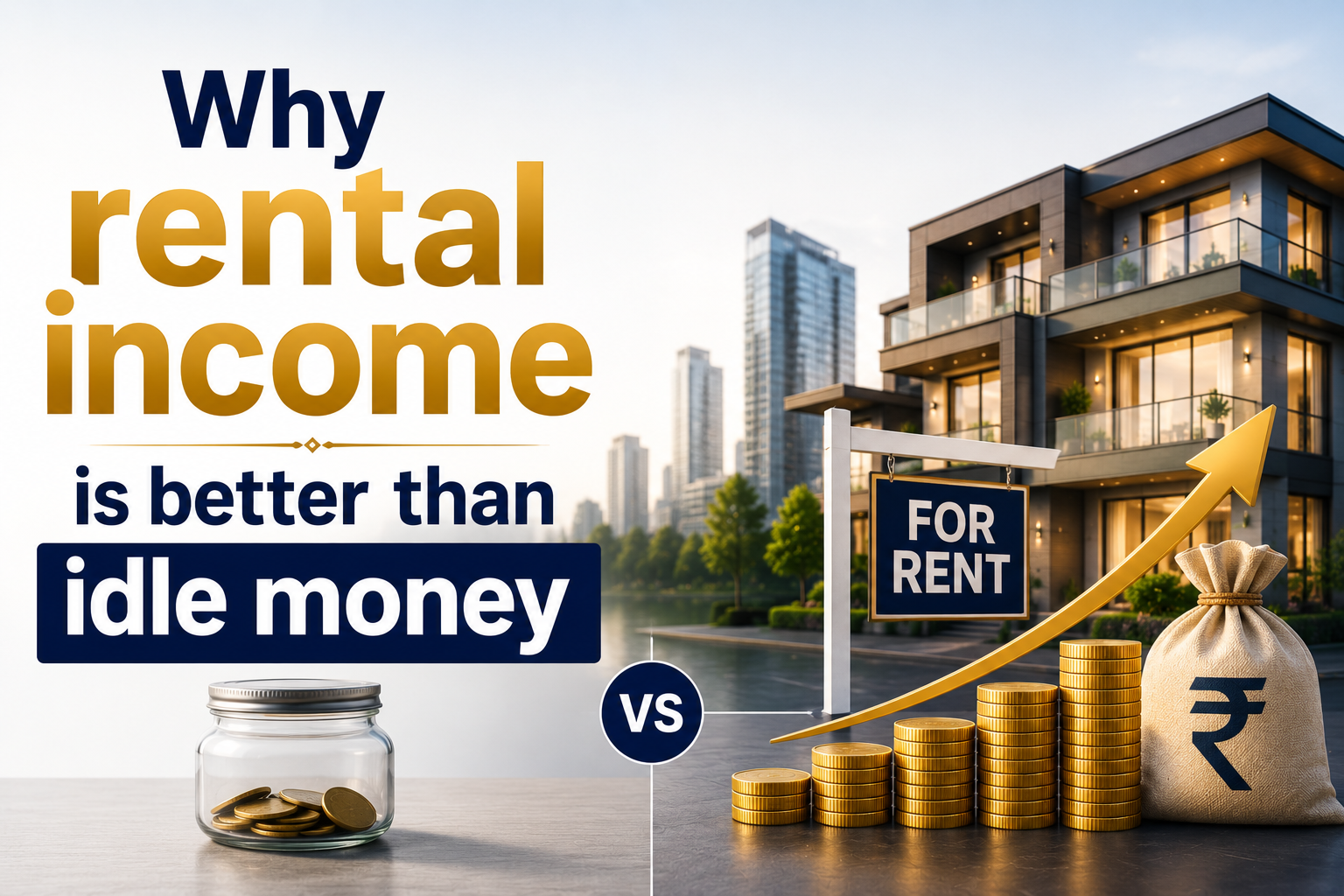
Why rental income is better than idle money
Your Idle Cash Isn't "Safe"—It"'s Quietly Losing Value Every Year
Most people who keep a large chunk of savings sitting in a bank account describe it as "playing it safe." We understand the instinct. But it's worth naming what's actually happening underneath that sense of safety, because it's not quite what it feels like.
India's retail inflation was running at 4.38% in June 2026, the highest reading in over a year. A standard savings account at most major banks pays somewhere between 2.5% and 4% — meaning the money sitting there is, in real terms, worth less every single year, even though the number on the screen keeps ticking upward. That's the part that gets missed. The account balance grows. Your actual purchasing power doesn't.
This isn't an argument against having cash at all—we'll get to that. It's an argument for being honest about what "safe" actually means, and for putting money that's genuinely sitting idle to better use.
Why "Keeping Money Safe" and "Keeping Money Idle" Aren't the Same Thing
There's a real difference between money you need to protect and money you're simply not doing anything with. Protecting money means keeping it liquid and low-risk for a genuine reason — an emergency fund, a near-term expense, a planned purchase. Idle money is different: it's capital sitting around with no specific purpose, parked in a savings account mostly out of habit or because moving it feels like effort.
The confusion between these two categories is where a lot of financial stagnation quietly happens. People feel responsible for keeping cash "safe," when in reality, letting a large surplus sit idle for years is its own kind of risk — just a slower, less visible one than a bad investment. Inflation doesn't announce itself the way a stock market crash does. It just erodes value steadily in the background, which is exactly why it gets ignored.
What Idle Money Actually Costs You Over Time
Let's put real numbers to this. If your savings account pays 3.5% and inflation runs at 4.38%, you're losing close to 1% of real value every year just by holding cash — before even accounting for tax on that interest, which erodes it further. Over 10 years, on ₹20 lakh sitting idle, that's a meaningful chunk of purchasing power gone, not because anything went wrong, but simply because nothing was done.
Fixed deposits look better on paper — top banks are currently offering 6.5% to 8% depending on tenure — but once you factor in tax on FD interest (added to your income and taxed at your slab rate), the post-tax real return for someone in a 30% tax bracket often ends up hovering close to zero, or even slightly negative, once inflation is subtracted. FDs aren't a bad tool. They're just frequently misunderstood as "growth," when for most taxpayers, they're closer to a break-even holding pattern.
Where Most People Park "Safe" Money, and Why It Underperforms
Savings accounts are built for liquidity, not growth, and it shows — most major banks pay 2.5-4%, well below current inflation, meaning money sitting here for years is guaranteed to lose real value, however safe it feels.
Fixed deposits do better nominally, but the post-tax, post-inflation picture is often underwhelming, particularly for anyone in a higher tax bracket. FDs make sense for short-term capital preservation and genuine emergency funds — they're a poor vehicle for long-term wealth building specifically because that's not the job they're designed to do.
Cash held "for emergencies" beyond a reasonable buffer is the most common version of this mistake we see. A buffer of 3-6 months' expenses is sound financial planning. Multiples of that, sitting untouched for years "just in case," is money that's not actually protecting you from anything — it's just quietly losing value while waiting for a need that may never arrive at that scale.
How Rental Income Compares
This is where the comparison becomes concrete. Residential rental yields across most Indian cities typically run 2-5% gross—modest on their own, but that's before accounting for the second component idle cash and FDs simply don't have: capital appreciation. A property generating even a modest 3% rental yield, combined with 5-7% annual appreciation in a reasonably chosen location, produces a total return that comfortably outpaces both inflation and any savings account or FD, often by a significant margin over a 10-15-year horizon.
Commercial property pushes this further. Pre-leased retail and office space typically yields 6-12% depending on asset type, with office space around 6-10% and warehousing or logistics assets often reaching 7-10%. That's a real, contracted monthly income—considerably more than a savings account offers, and it comes with an appreciating asset underneath it, not just a number that grows through compounding interest alone.
The comparison isn't really close once you look at it honestly. Idle cash defends against inflation poorly. Rental income, especially combined with the appreciation that comes with real estate ownership, is built to outpace it.
Why Rental Income Feels Different Psychologically Too
There's a behavioral piece to this that's worth naming, because it genuinely affects how people manage money over time. A savings account statement is abstract — a number that moves slowly and rarely prompts any action. A rental check landing in your account every month is tangible. It's a repeated, visible signal that your money is actually working, and several of our clients have told us this changes how engaged they stay with their broader finances—once they see one asset actively generating income, they tend to look more critically at the rest of their portfolio too, rather than letting everything else sit on autopilot.
This isn't a purely financial argument, but it's a real one. Money that's visibly working tends to get managed more actively than money that's just sitting somewhere, quietly doing nothing.
This Isn't a Case for Zero Cash—It's a Case for the Right Amount
To be genuinely fair to the other side of this: liquidity matters, and not all cash should be moved into income-generating assets. A 3-6 month emergency fund, money earmarked for a near-term expense, and a reasonable buffer for unplanned needs should stay liquid, in a savings account or a short-tenure FD, regardless of what inflation is doing to it in the background. That's not idle money — that's money doing exactly the job it's meant to do.
The distinction this piece is making is specifically about surplus beyond that buffer—capital that's been sitting untouched for years with no defined purpose, simply because moving it felt like more effort than leaving it alone.
What to Actually Do With Idle Money Instead
Start by properly sizing your emergency fund, then treat anything beyond that as genuine surplus rather than an extension of your safety net.
Consider pre-leased commercial real estate if you want meaningfully better cash flow and are comfortable with a longer holding period and lower liquidity than a savings account offers.
Look at SM REITs if direct property ownership feels like too large a commitment—these offer real estate-linked income with far more liquidity, at entry points starting around ₹10 lakh.
Consider mutual funds if you're comfortable with market-linked volatility in exchange for potentially stronger long-term average returns and better liquidity than physical real estate.
Revisit this allocation periodically, rather than treating it as a one-time decision—as your income, goals, and risk tolerance change, so should the split between liquid buffer and income-generating assets.
Frequently Asked Questions
1. How much idle cash should I actually keep?
Generally 3-6 months of expenses as a genuine emergency fund. Beyond that, holding large sums in a savings account for years is more often inertia than sound planning.
2. Is rental income really better than fixed deposit returns?
Often yes, once you account for FD taxation and inflation, rental income combined with property appreciation tends to outpace FD real returns over a 10+ year horizon, though it comes with lower liquidity and more upfront capital.
3. What's a realistic rental yield to expect in India right now?
Residential yields typically run 2-5% gross, while commercial property (retail, office, warehousing) generally runs 6-12%, depending on asset type and location.
4. Isn't real estate riskier than keeping money in a bank?
It carries different risks—illiquidity and vacancy risk, for instance—rather than being risk-free. But "safe" cash carries its own risk too: guaranteed erosion of purchasing power to inflation over time, which is often overlooked simply because it happens quietly.
5. Should I move my entire emergency fund into rental property?
No — liquidity for genuine emergencies should stay in cash or short-term instruments. This is specifically about surplus beyond that buffer, not your full safety net.
Ready to Put Your Idle Money to Work?
If you've got surplus sitting in a savings account with no real purpose beyond habit, it's worth having an honest conversation about what that money could actually be doing instead.
Get in touch with Digital Gurukul Realty for a free consultation on rental income and commercial real estate opportunities.