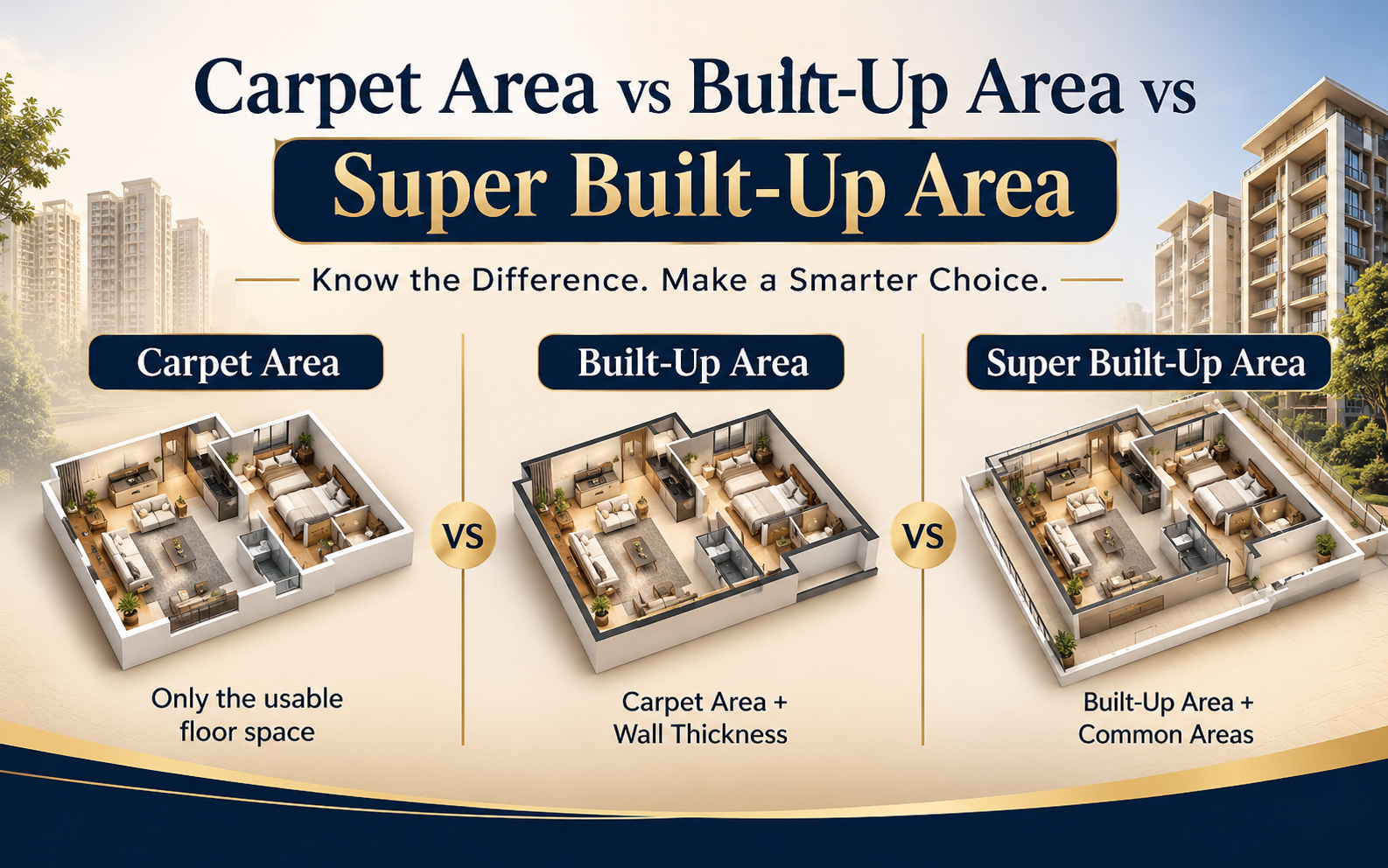
Carpet Area vs Built-Up Area vs Super Built-Up Area: Understanding the Difference
Two flats can both be advertised as "1,200 sq ft" and still offer very different living space. The reason is how the area is measured. Knowing the difference between carpet area and super built-up area helps you compare prices fairly and avoid surprises at the time of possession.
In short: carpet area is the space you can actually use inside the flat, built-up area adds the walls and balcony, and super built-up area adds your share of common areas. This guide explains each term, shows a numerical example and lists what to check before you buy.
What Is Carpet Area in Real Estate?
Carpet area meaning, in simple words: the floor area where you can lay a carpet wall to wall. It is the truly usable space inside your home.
What Does Carpet Area Include?
- Bedrooms, living room, kitchen and dining space
- Bathrooms and toilets
- Internal passages inside the flat
- The thickness of internal partition walls (as per RERA)
What Is Not Included in Carpet Area?
- External walls
- Service shafts
- Exclusive balcony or verandah area
- Exclusive open terrace area
- Lobbies, staircases, lifts and other common spaces
What Is Built-Up Area?
Built-up area meaning: the carpet area plus the area occupied by walls and other attached spaces that belong only to your flat.
Components Included in Built-Up Area
- Carpet area
- Thickness of internal and external walls
- Exclusive balcony or verandah
- Service shafts attached to the flat
How Is Built-Up Area Different from Carpet Area?
This is the core of the carpet area vs built-up area question. The carpet area is the usable floor space, while built-up area also counts the wall thickness and exclusive balcony. So built-up area is always larger than carpet area for the same flat.
What Is Super Built-Up Area?
Super built-up area meaning: the built-up area plus a proportionate share of the building's common areas. It is a commonly used industry term, not a term defined in the RERA Act.
What Are Common Areas?
These are spaces shared by all residents:
- Lobbies and corridors
- Staircases and lift shafts
- Clubhouse, gym and community hall
- Security room, generator room and similar utilities
Understanding the Loading Factor
Loading factor is the extra percentage added to the usable area to arrive at the super built-up area. It differs from project to project, so there is no standard figure. The same builder may even use different loadings in different towers.
Difference Between Carpet Area, Built-Up Area and Super Built-Up Area

Carpet Area vs Built-Up Area vs Super Built-Up Area: Practical Example
Here is an illustrative example. These numbers are only for understanding and are not a universal industry ratio.
- Carpet area: 800 sq ft
- Wall thickness and exclusive balcony: 160 sq ft
- Built-up area: 960 sq ft
- Share of common areas: 240 sq ft
- Super built-up area: 1,200 sq ft
Now see how this affects price. At ₹10,000 per sq ft on super built-up area, the flat costs ₹1.2 crore. But you only get 800 sq ft of usable space, so the effective cost is ₹15,000 per sq ft of carpet area. This is why comparing only the headline rate can mislead you.
What Is RERA Carpet Area?
The Real Estate (Regulation and Development) Act, 2016 defines carpet area as the net usable floor area of an apartment. Under this definition:
- Included: the area covered by internal partition walls of the apartment
- Excluded: external walls, areas under service shafts, exclusive balcony or verandah area, and exclusive open terrace area
The Act does not define built-up or super built-up area. Those remain common industry terms. Always check how your state's rules and your sale agreement apply the carpet area definition.
Which Area Should You Consider Before Buying a Property?
RERA carpet area should be your main reference, because it is legally defined and reflects the space you can use. Super built-up area is still useful, but only as a pricing and marketing figure.
- Compare carpet area across projects, not just super built-up area.
- Check the carpet area stated in the agreement for sale and the approved project details.
- Compare the usable area of different flats of similar size to judge efficiency.
Important Things to Check Before Buying a Property
A little homework saves a lot of regret later. Keep these points in mind:
- Ask for all three areas in writing: carpet, built-up and super built-up.
- Calculate the effective rate per sq ft of carpet area, not just the advertised rate.
- Understand the loading factor and ask how it was calculated.
- Study the floor plan to see if the layout makes good use of the space.
- Verify RERA disclosures on your state's RERA website, including the registered carpet area.
- Read the agreement carefully before signing, and consult a legal professional if needed.
How Digital Gurukul Realty Helps You Make Informed Property Decisions
Buying a home is rarely just about the flat. It's about the neighbourhood, the builder, the paperwork and whether the numbers really work for you. That's where Digital Gurukul Realty comes in.
We're a real estate advisory brand working across premium residential and commercial properties in Delhi NCR. Our job is simple: help you understand the location, read the project details properly and match your options to what you actually need.
Frequently Asked Questions (FAQs)
1. What is the main difference between carpet area and built-up area?
Carpet area is the usable floor space inside the flat. Built-up area adds the thickness of walls and exclusive spaces such as the balcony to the carpet area.
2. Is super built-up area always bigger than built-up area?
Yes, in general. Super built-up area includes the built-up area plus a share of common areas, so it is larger.
3. Which area is mentioned in RERA?
RERA defines and uses carpet area. Built-up and super built-up area are not defined in the Act.
4. How can I calculate carpet area from super built-up area?
There is no fixed formula, because the loading factor varies by project. If the loading is known, carpet area ≈ super built-up area ÷ (1 + loading). In our example, 1,200 ÷ 1.5 = 800 sq ft. Always confirm the actual figure from the agreement.
5. Why is carpet area important when buying a flat?
It shows the space you can actually use and live in. It also helps you compare the real cost per sq ft across different projects.