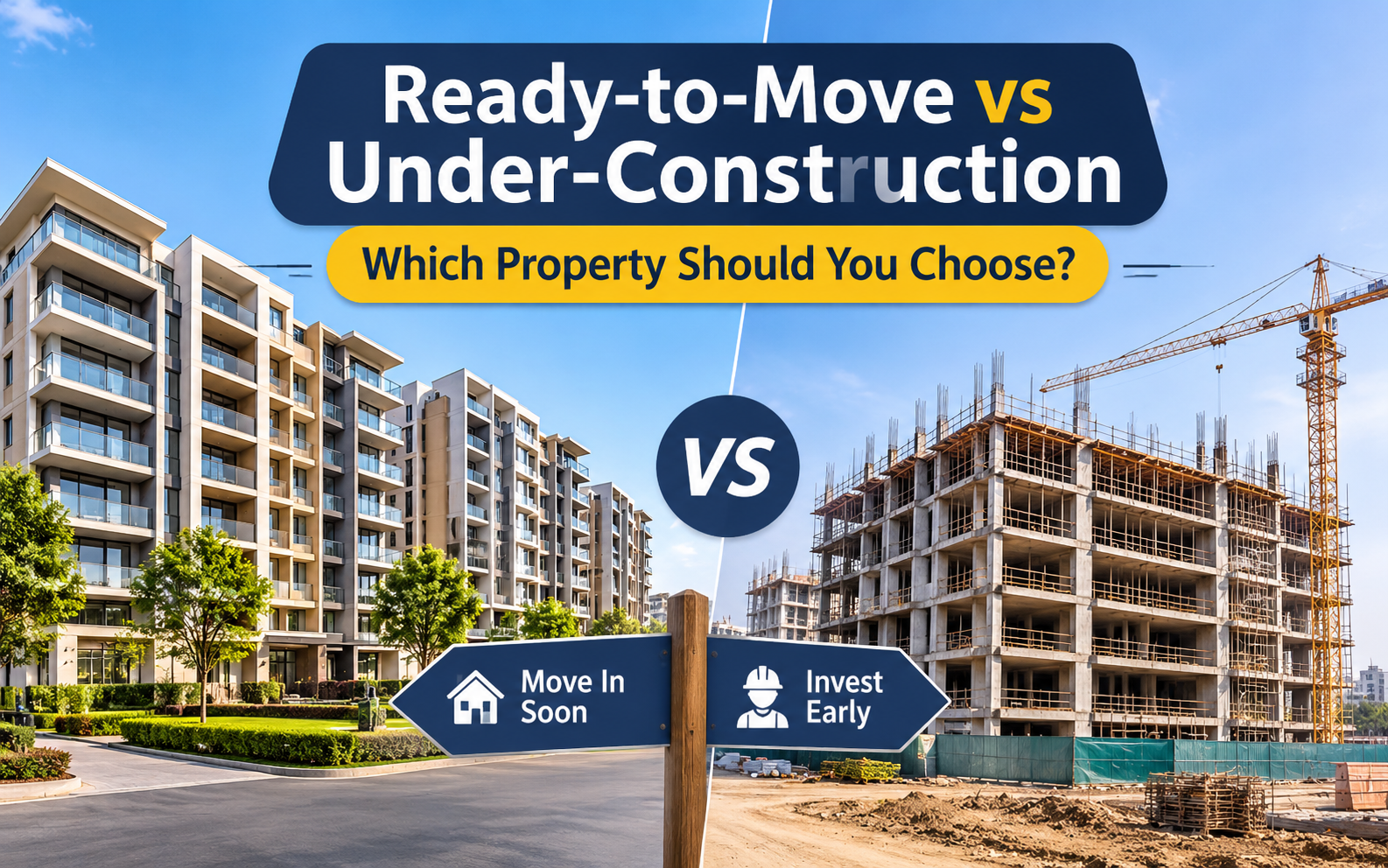
Ready-to-Move or Under-Construction Property: What Should You Choose?
Buying a home is rarely a quick decision, and one of the first questions every buyer faces is the ready-to-move vs under-construction property debate. One lets you walk into a finished flat. The other lets you buy early, pay in stages and wait for possession.
Neither is automatically better. The right choice depends on your budget, your timeline and your tolerance for uncertainty. This property buying guide breaks down both options so you can decide with confidence, whether you are buying a home to live in or planning real estate investment in Delhi NCR.
What Is a Ready-to-Move Property?
A ready-to-move property is a completed project where construction is over and possession can be taken almost immediately. In most cases, the builder has already received the Occupancy Certificate (OC) or Completion Certificate (CC) from the local authority.
Key characteristics:
- The flat or unit physically exists, so you can inspect it before paying.
- Possession follows registration and payment formalities, not a construction schedule.
- The society, common areas and surrounding neighbourhood are usually visible and lived in.
What Is an Under-Construction Property?
An under-construction property is a project that is still being built, from foundation work to structure, finishing and handover. You buy based on the builder's plans, specifications and agreement.
Possession is promised for a future date, which should be mentioned in the builder-buyer agreement and in the project's RERA registration. Payment is usually linked to construction milestones, so you pay in instalments as the work progresses rather than the full amount upfront.
Ready-to-Move vs Under-Construction Property: Key Differences

On GST: it applies to the construction service, which is why a flat sold after the completion certificate is issued does not attract it. If you buy before the certificate is issued, the purchase is treated as under-construction, even if you receive possession shortly afterwards. Rates can be revised by the GST Council, so confirm the current position with a tax professional before booking.
Pros and Cons of Ready-to-Move Properties
Advantages of Ready-to-Move Property
The benefits of ready-to-move property are mostly about certainty:
- Immediate possession: You can move in, or hand over keys to a tenant, without a long wait.
- See what you buy: You can check finishing, ventilation, light, water pressure and neighbours first-hand.
- No waiting period: You avoid paying rent and EMI at the same time.
- Quicker rental use: Rental income can begin soon after possession, though returns vary by location and demand.
Disadvantages of Ready-to-Move Property
- Higher upfront requirement: You typically need a larger share of the amount early on.
- Limited customisation: Layouts and specifications are already fixed.
- Fewer choices in established areas: In mature locations, good ready inventory can be limited.
Pros and Cons of Under-Construction Properties
Advantages of Under-Construction Property
The advantages of under-construction property mostly relate to flexibility and entry price:
- Flexible payment plans: Construction-linked payments spread the cost over time.
- More choice: Newer projects often offer a wider range of layouts and configurations.
- Potential appreciation: Value may rise as the project and its surroundings develop, but this is never guaranteed.
- Early entry: You can buy into an upcoming location before it matures.
Disadvantages of Under-Construction Property
- Possession delays: Projects can run behind schedule.
- Delivery uncertainty: Funding, approvals or builder issues can affect completion.
- Hard to judge final quality: You rely on brochures, show flats and the builder's reputation.
- Changing conditions: Timelines or planned infrastructure around the project may change.
Which Property Is Better for Homebuyers and Investors?
There is no universal winner. Here is how each option tends to fit:
- Buyers who need immediate possession: Ready-to-move is the practical choice, especially if you are paying rent or have a fixed move-in date.
- Families shifting to a new home: Ready homes avoid delays around school admissions, jobs and life events.
- Investors with a longer horizon: Under-construction projects may suit those who can wait and absorb some risk, with an entry price that is often lower.
- Buyers seeking capital appreciation: Early-stage purchases may offer upside, but appreciation depends on the builder, location and market conditions. It should never be assumed.
When buyers ask which property is better for investment, the honest answer is that the quality of the project and the builder usually matters more than the construction stage.
Buyers considering long-term property ownership can also explore professional real estate investment advisory to evaluate locations, projects and investment requirements.
Important Things to Check Before Buying a Property
- RERA registration: Check the project's registration number and details on the official RERA portal, including the declared completion date.
- Builder's track record: Look at past projects, delivery history and any disputes.
- Location and infrastructure: Visit the area. Check connectivity, social infrastructure and any planned development from official sources.
- Total cost: Ask for a full cost sheet covering base price, parking, club membership, maintenance deposits, GST where applicable, stamp duty and registration.
- Possession and legal paperwork: Read the agreement carefully for possession dates, delay terms and title documents. Consider having a lawyer review it.
- For ready-to-move properties: Verify the Occupancy Certificate (OC) and applicable completion approvals, and confirm utility connections and society handover.
For example, buyers evaluating emerging markets can explore properties on Dwarka Expressway to understand the residential opportunities in this growing corridor.
How Digital Gurukul Realty Helps You Choose the Right Property
Digital Gurukul Realty (DGR) is a premium real estate consultancy offering residential and commercial property advisory across Delhi NCR's key markets.
Our approach is to start with your situation, not a project. We look at your budget, timeline, end-use or investment goals and risk comfort. We then help you compare locations, projects and payment structures, so you can see what a ready home or an under-construction one would mean for you in practice.
The aim is simple: to help buyers and investors make informed property decisions, with clear information and no pressure.
Explore premium property opportunities across Gurugram and other key Delhi NCR locations with Digital Gurukul Realty.
FAQs:
1. Is a ready-to-move property better than an under-construction property?
Not always. Ready-to-move offers certainty and immediate use. Under-construction offers flexibility and often a lower entry price. The better option depends on your goals and risk appetite.
2. Is GST applicable on ready-to-move and under-construction properties?
GST generally applies to under-construction residential units at 5% (without input tax credit), or 1% for affordable housing. It does not apply to flats sold after the completion certificate is issued, or to resale flats. Rules can change, so verify before you buy.
3. Which property is better for long-term investment?
It depends on the project, builder, location and your holding period. Under-construction units may suit longer horizons, while ready units suit those wanting quicker rental income. Returns are never guaranteed.
4. What are the risks of buying an under-construction property?
The main risks are possession delays, project stalls, differences between promised and delivered quality, and changes in surrounding development. Checking RERA details and the builder's record reduces, but does not remove, these risks.
5. What should I check before buying a ready-to-move flat?
Verify the Occupancy Certificate, title documents, RERA details (where applicable), pending dues, society approvals and the physical condition of the unit. Inspect it in person before paying.
Conclusion
The ready-to-move vs under-construction property decision comes down to timing, budget and risk. Ready homes give peace of mind. Under-construction homes give flexibility and early entry. Whichever you prefer, verify the paperwork and the builder first.
If you would like help comparing options across Delhi NCR, the team at Digital Gurukul Realty is happy to guide you.